
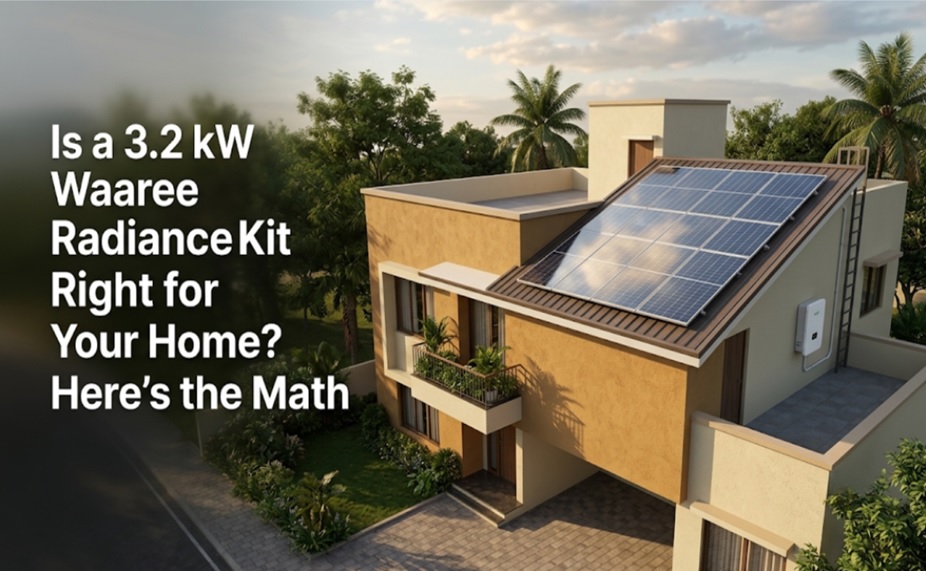
Before getting into specs and components, the real question most homeowners actually want answered is simpler: does a 3.2 kW system make sense for my house, and what am I actually getting for the money?
Working Out If 3.2 kW Fits Your Home
A rough rule most installers use is that 1 kW of solar capacity generates about 4 units of electricity daily in India, roughly 120 units a month. That puts a 3.2 kW system in the range of 350 to 400 units monthly, depending on your location and sunlight availability. If your household typically consumes somewhere between 300 and 400 units a month, this capacity is likely to offset a substantial chunk of your bill, sometimes close to all of it during sunnier months.
What You’re Actually Paying For
The Radiance 3.2 kW kit is currently priced around ₹1.3 to 1.42 lakh depending on the seller and listing, before any subsidy is applied. Under PM Surya Ghar Muft Bijli Yojana, eligible homeowners can bring this cost down significantly, sometimes by tens of thousands of rupees depending on system size and state level incentives.
The Spec Sheet, Quickly
| Specification | Value |
| Brand | Waaree |
| Power Output | 3200 Watts |
| System Type | On grid, single phase |
| Module Type | Bifacial TOPCon DCR |
| Panel Model | BiN-08 series (560 to 585 Wp) |
| Quantity | 1 complete kit |
Why Buying It as a Kit Beats Buying Parts Separately
If you priced out a bifacial TOPCon panel set, a compatible string inverter, junction box, MC4 connectors, and both AC and DC cabling individually, you’d likely spend more overall and still carry the risk of mismatched ratings between components. The kit format bundles all of this at a fixed price point with guaranteed compatibility, which is often the bigger hidden cost people don’t account for when comparing DIY component pricing against a packaged kit.
What the Bifacial TOPCon Panels Actually Bring to the Table
The included BiN-08 modules use TOPCon cell technology, currently one of the more efficient options available in the Indian residential market. Because they’re bifacial, they also capture reflected light hitting their rear surface, which adds measurable extra output over a standard front-only panel, particularly useful if your rooftop reflects some light upward.
How the System Performs Day to Day
Power generated by the panels flows through the string inverter, which converts it to usable AC electricity for your home. Since this is an on-grid setup, any electricity you generate but don’t immediately use gets exported to the grid through net metering, effectively banking credit against future consumption. It’s worth remembering this system doesn’t provide backup during outages on its own, since that requires a battery-equipped hybrid version instead.
What Affects Your Actual Savings
Real-world output depends on a handful of variables beyond just the kit itself. Your local sunlight levels, roof orientation, any shading from nearby structures, installation quality, and even your own daily consumption pattern all influence how much you actually save month to month. A well-oriented, unshaded roof in a sunny region will naturally outperform a shaded or poorly angled installation, even with identical equipment.
The Long Game
Solar systems aren’t a short-term purchase; they’re built to run for decades. Waaree backs the Radiance panels with a 12-year product warranty and a 30-year power output guarantee, while the inverter carries an 8-year warranty. Over that timeframe, the electricity bill savings typically far outweigh the upfront cost, especially as grid tariffs continue rising year over year.
Buying One
The Radiance 3.2 kW kit is available through Waaree’s own online store and on Amazon, with current pricing hovering around ₹1.35 lakh depending on the listing and availability at the time of purchase.
For a household consuming in the 300 to 400 unit range monthly, this configuration offers a genuinely balanced entry point into rooftop solar, backed by warranty coverage and manufacturing scale that gives some real confidence behind the investment.
